Beginner's Guide to Identifying Common River Birds by Behavior
Most beginners try to identify a river bird by staring at its feathers. It rarely works. River birds are often backlit, half-hidden, moving fast, or a hundred metres away, and the details that fill a field guide — wingbars, bill length, leg colour — are exactly the details you cannot see. What you can see, from the first second, is what the bird is doing: how it sits on the water, whether it walks or dives, whether it hunts from a perch or stalks the shallows. Behaviour is a filter. Learn six or seven patterns and the long list of possibilities collapses into two or three candidates, which you can then confirm with a closer look or a second visit.
Read the water in zones before you look for birds
A river is not one habitat. It is a strip of several, stacked side by side, and each one hosts a different cast. Before you lift your binoculars, spend five minutes mapping the stretch in front of you.
- Riffles: shallow, fast, broken water over gravel. Loud, oxygen-rich, and home to the birds that hunt in current.
- Pools: deeper, slower, smoother. Look here for swimmers and divers.
- Margins: the shallow edge, silt, reeds, overhanging grass. Dabblers, wagtails and young fish.
- Banks and structures: undercut earth, tree roots, bridge footings, weir walls, moored boats. Perches, nest sites, and hiding places.
- Mid-channel rocks and fallen trees: the perches that plunge-divers and tail-pumping walkers both use.
- The air above: a zone in its own right, busy with insect hunters in warm weather.
Scan the zones in order, slowly, and then again. Many river birds sit still for long stretches and reveal themselves only when they move — which is precisely the moment your behaviour knowledge pays off.
The perch-and-plunge hunter: a flash, a splash, a return
If you see a small bird drop vertically from a low perch into the water, vanish for a second, and fly back up with something silver, you are almost certainly watching a kingfisher. The flight is the giveaway even when the colour isn't: fast, low, straight along the channel, usually below head height, following the river's curve rather than cutting across it. Beginners often notice the bright blue only after the bird has gone, which is why the sound matters — a thin, high whistle, often heard before the bird is seen.
Kingfishers hunt from a favourite perch and return to it repeatedly, so if a bird flies off, stop, wait, and keep your eyes on the same stump or branch. Watch the plunge itself: a steep, compact entry, then a quick rise and a short flight back to the perch, where the fish is usually manipulated before being swallowed. If the bird is hovering over the water before dropping, look again — that is a different set of skills, and often a different species.
The birds that walk into the water
Some river birds treat the current as a pavement. The dipper is the classic: a compact, dark bird with a white bib, standing on a wet stone in the middle of a riffle and bobbing, a habit so constant it looks like a nervous tic. Then it does something no other small river bird does — it walks straight in, disappears under the surface, and reappears upstream, having walked along the bed against the flow. If you see a bird vanish into white water and pop up a few metres up-current, you have your identification.
Grey wagtails share the same real estate but behave differently. They pump the tail almost continuously — down and up, down and up — and their flight is bounding and undulating rather than level. They work the weir edges, gravel banks and wet margins, often running a few steps, stopping, and flicking into the air to catch an insect before landing on the same stone. A common sandpiper on a shingly bank will instead teeter: the rear of the body bobbing up and down while the head stays fairly level, and its low flight over the water is stiff-winged and slightly bowed.
The patient stalker in the shallows
Grey herons are the easiest river bird to find and the easiest to misread as doing nothing. A standing heron may hold position for several minutes, neck folded back into a question mark, before striking so quickly that the movement is over before your eyes catch it. Beginners often walk past a heron because it has not moved; the trick is to look for the shape, not the action. Check the shallow margins, the tail of a pool, the edge of a weir, and any spot where a bank gives a view over open water.
White birds stalking the same shallows behave in a visibly busier way. A little egret often shuffles its feet, or vibrates one leg in the silt, to flush small fish and invertebrates before stabbing at them. That foot-stirring is a useful tell: a motionless, coiled, grey-brown bird is likely a heron; a bright white bird actively working a line of shallow water with quick steps and jabs is likely an egret. Watch from a distance and keep low — both species are quick to move off if you appear on the skyline.
Behaviour gives you the family in seconds. Plumage only confirms what the movement already told you.
Three swimmers, three ways of sitting in the water
Look at how much of a bird is above the surface. That single observation sorts most swimming river birds into groups.
- Sitting high and dry: mallards, moorhens and coots ride buoyantly with much of the body clear of the water. Mallards upend — tail up, head down — to reach submerged plants. Moorhens swim with a jerky, head-bobbing motion and flick their tails; coots are more at home in open water and patter across the surface to get airborne.
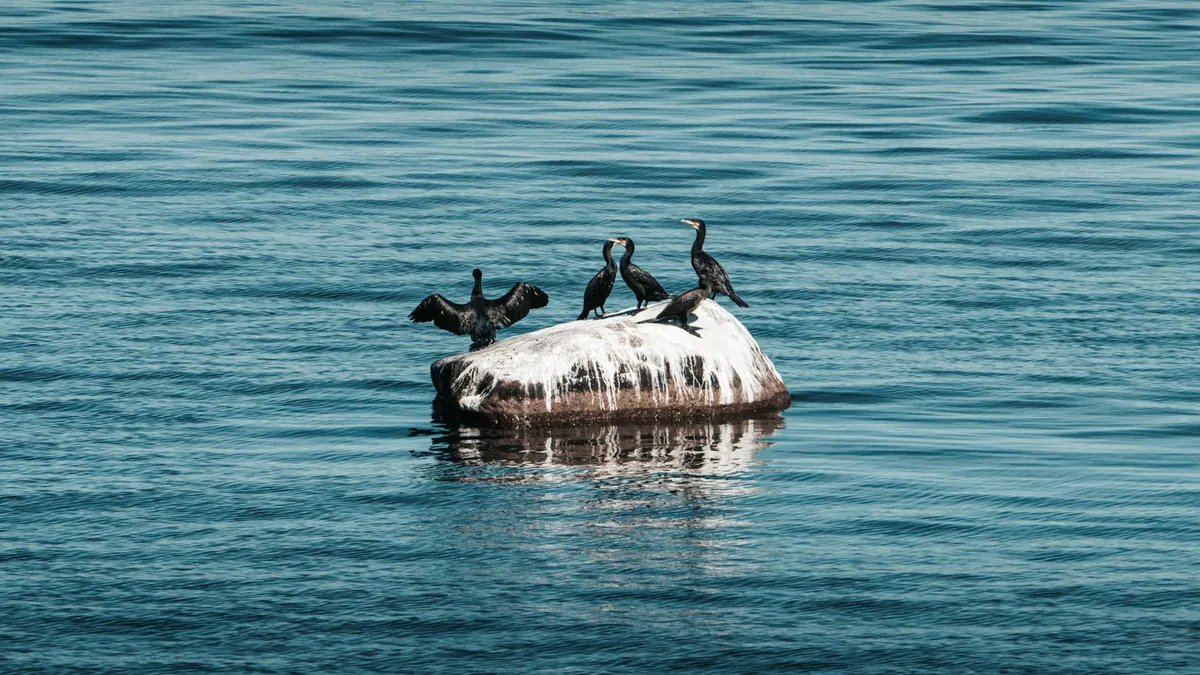
- Sitting low: cormorants ride deep, sometimes with only the head and long neck showing, and they sink rather than leap when they dive. Look for them standing on posts or rocks with wings held out to dry.
- Small, round and sudden: little grebes float like small dark corks and dive with an audible plop, often after a quick forward shuffle. Sawbills such as goosanders dive with a smooth, rolling forward motion and surface at an angle, bill first.
The direction of a dive is worth noting too. A bird that slips under quietly and travels a long way is hunting fish. A bird that dips its head, tips forward, and comes up almost in the same place is feeding on the surface or just below it.
Birds of the air above the water
On warm days the space over a river fills with insect hunters, and their flight heights separate them. Sand martins work low, often within a metre of the surface, in loose groups, with a dry twittering call; they are brown above and pale below, without the long streamers of a swallow. Swallows fly a little higher and mix glides with quick bursts, their tail streamers obvious in a turn. Swifts are higher still, dark and scythe-shaped, screaming, and they never land. Wagtails and flycatchers, meanwhile, launch short sorties from a stone and return to the same spot — a pattern of repeated, short flights from a fixed perch rather than a continuous wander.
A behaviour-first field checklist
- Vertical plunge from a low perch, fast low flight along the channel: kingfisher.
- Bobbing on a mid-river stone, then walking underwater: dipper.
- Constant tail-pumping on a weir edge or gravel bank, bounding flight: grey wagtail.
- Motionless, coiled stance in the shallows, lightning strike: grey heron.
- White bird shuffling or vibrating its feet in shallow water: little egret.
- Low in the water, sinking quietly, drying wings on a post: cormorant.
- Small dark cork diving with a plop: little grebe.
- Head-bobbing swim and flicked tail near vegetation: moorhen.
How to practise this on your next walk
Pick one spot — a bend, a bridge, a weir pool — and stand still for fifteen minutes rather than walking a kilometre. Note the behaviour first, in plain words, before you attempt a name: "sat low, dived with a plop, came up three metres downstream." Then match the note to a species. Keep the same time of day across visits, because light direction changes what you can see, and record the water level and season alongside your notes; a river in spate and a river in late summer hold different birds in different places.
Learn five species properly before adding more. Dipper, grey wagtail, kingfisher, grey heron and mallard will carry you through most beginner walks on a river, and each one teaches a behaviour pattern that transfers to species you meet later. Keep your distance from banks, nests and young birds, stay on established paths, and if a bird changes its behaviour because of you — stopping feeding, looking up, moving away — you are too close. Take one step back, wait, and let the river resume. That pause is usually when the best behaviour appears.
Photo: Raul Ling / Pexels

River Towns vs. Riverside Villages: Choosing Where to Stay for a Slow Weekend
A river town gives you a station, a market and dinner options; a riverside village gives you mist, quiet...
What to Wear for a Cold-Weather River Walk: A Seasonal Checklist
A practical, season-by-season guide to layering, footwear and small essentials so a windy, muddy or frosty...
About Us