Tripod vs. Handheld: Shooting Moving Water in Daylight
Two photographers stop at the same bend in the river. One plants a tripod in the gravel and starts threading on a filter; the other crouches low, elbows braced on a knee, and fires off a burst. Both go home with frames they like. That is the honest answer to the tripod-versus-handheld question: the support you choose should follow from the water you are trying to make, not from habit. A river in spate at noon and a slow pool under alders at dusk ask for completely different shutter speeds, and each speed points to a different way of holding the camera. Here is how to decide quickly, and how to shoot well once you have.
Start With the Shutter Speed, Not the Tripod
Most debates about stabilization are really debates about exposure time in disguise. Decide how you want the water to look, then work backwards to the shutter speed that produces it, then ask whether you can hold that speed by hand. That order of thinking settles the matter in seconds.
As a rough guide, measured at a typical river focal length:
- 1/1000 s and faster — droplets suspended, spray sharp, waves caught mid-crest. Handheld territory.
- 1/250–1/500 s — most of the splash frozen, a little life left in the bigger waves. Handheld, comfortably.
- 1/60–1/125 s — the natural, textured middle. Some streaks, some detail. Handheld with care, or braced.
- 1/8–1/30 s — visible streaking; foam turns to threads. Tripod or firm improvisation strongly preferred.
- 1/2 s–4 s — classic silky water, smooth sheets between rocks, still pools gone glassy.
- 8 s and longer — water merges into mist; anything that moves disappears.
When the Tripod Earns Its Weight
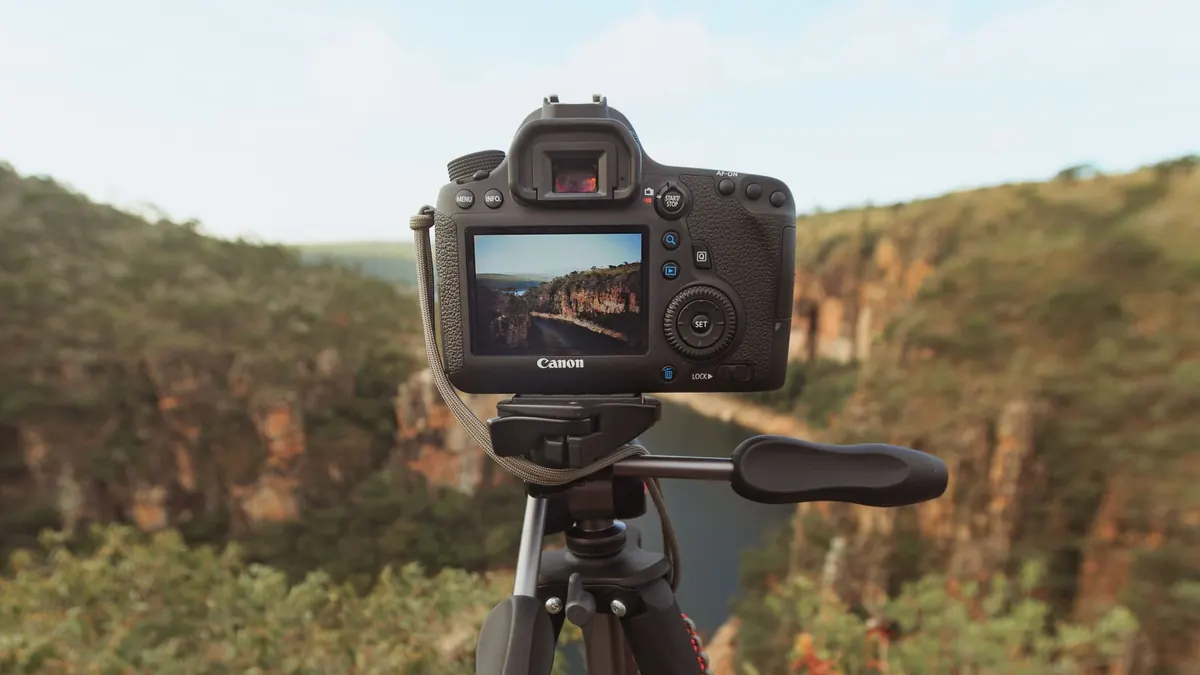
Daylight long exposures are the clearest case. To get a two-second exposure at midday you need to cut light drastically, with a neutral density filter of six or ten stops, and once the camera is committed to a filter and a slow shutter, handholding is out. The tripod is not a nicety there; it is the whole method.
Beyond the obvious, a tripod buys you three quieter things. It lets you compose precisely in live view and keep the framing while you wait for a kayak or a heron to enter the frame. It lets you shoot a bracketed set or a focus stack without the camera shifting between frames. And it slows you down, which is often the real benefit: on a riverbank, the second and third compositions are usually better than the first.
Making a long exposure actually sharp
Silky water hides motion blur badly but shows camera shake instantly. Extend the center column last or not at all, hang a bag from the hook if there is one, and set a two-second timer or use a remote so your hand is off the camera at the moment of exposure. Switch off image stabilization when the camera is locked down, and if your camera offers electronic first curtain or a fully electronic shutter, use it — the mirror and the mechanical shutter are both sources of vibration at slow speeds. On a breezy day, stand upwind of the tripod and shield it with your body during the exposure.
When Handheld Is the Right Call
Fast water is not the only reason to travel light. Rivers are often reached by scrambling over wet rock, and a tripod is a third hand you do not have. Fishing rivers, tidal estuaries and narrow gorges lined with alders are all places where a compact handheld kit gets you shots that a tripod never would, because you can move three meters in the time it takes to fold the legs.
Handheld also wins on subjects that are not really about the water at all. A heron lifting off, a dog shaking itself dry on the shingle, a friend wading across — for these you want speed and reactions, not a leveled base. Freezing is the point: a splash caught at 1/1000 s shows you the shape of the impact, which the eye never quite sees.
Handheld craft
At the margins, technique does the work a tripod cannot. Tuck your elbows into your ribs, exhale halfway and hold, and shoot a short burst rather than a single frame — the second or third is often noticeably steadier. Use lens stabilization when the water is slow enough to allow it, raise ISO rather than risk a shutter speed two stops too slow, and never be shy about bracing against a fence post, a tree trunk or a boulder. A folded jacket on a rock, with the camera resting on it, is a legitimate support.
Two Situations Worth Naming
Shallow depth of field shot from a low angle: you are on your knees in the gravel, framing a midstream stone against a blurred bank. This is a handheld shot at 1/250 s with a wide aperture, and a tripod would put the camera at the wrong height anyway.
A still pool with a long reflection: the whole point is that nothing moves for two seconds. Tripod, polarizer to control glare off wet rock, and patience until the wind drops. No amount of good handheld technique substitutes here.
The Middle Ground Is Real
You do not have to choose between a full tripod and nothing. A monopod steadies a 200mm shot of a heron without slowing you down much. A beanbag on a boulder is faster than three legs on uneven ground. A clamp on a railing over a weir will hold a small camera for a two-second exposure when there is no room to stand. Even a walking pole, straps wrapped around it and the shutter on a timer, will buy you two stops.
A Routine for the Next Walk
- Before you unpack anything, look at the water and decide what it should look like: frozen, textured or silky.
- Read the light. If you need more than roughly 1/30 s at your preferred aperture and ISO, reach for support.
- Carry one light stabilizer — a small tripod or a beanbag — and a six-stop ND filter. Between them they cover nearly every river situation in daylight.
- Shoot the fast version first, handheld, while the light is still doing something. Then set up and take the slow one.
- Check the histogram and the focus point at full magnification before you leave the bank, while you can still fix it.
The habit worth building is simple: let the water decide, then use the support that gets you there. Some days that means wet knees and a burst of frames; other days it means standing still beside a locked-off camera for two full seconds, listening to the river run while the shutter stays open.
Photo: Matheus Bertelli / Pexels
River Towns vs. Riverside Villages: Choosing Where to Stay for a Slow Weekend
A river town gives you a station, a market and dinner options; a riverside village gives you mist, quiet...
What to Wear for a Cold-Weather River Walk: A Seasonal Checklist
A practical, season-by-season guide to layering, footwear and small essentials so a windy, muddy or frosty...
About Us